C4Now.org
Climb to Cure Crohn’s & Colitis
It is with great sadness that we report Trina Seligman has passed away due to complications from lung transplant surgery on 11/01/2023.
Trina was an incredibly talented doctor of Naturopathic Medicine, and while she had an incredibly active and rewarding life, she was taken far too soon from this world. She leaves behind her husband Craig and two two teenage children. We are so incredibly proud of our Trina and miss her every hour of every single day.
This website is a tribute and a chronical to some of her greatest adventures which she dedicated to the cause of raising money for the Crohn’s and Colitis Foundation.
C4Now.org
Climb to Cure Crohn’s & Colitis
When the famous English mountaineer George Mallory was asked “why do
you climb?” he retorted “Because it’s there”, possibly the most quoted 3
words in mountaineering. It is not a question asked of every athlete but we
ask to climbers as if to question their sanity or responsibility.
For me the answer is intricately entwined with a second more personal
question: How do you live with an autoimmune disease, an illness has no
cure?
“How long before my pain is gone?”
“How long before this treatment works?”
“How many days do I take this medication?”
0.0s
As a doctor, I am frequently asked these questions by my patients. People want answers, they want to know; they want an end-point to their disease. However there are no answers and no cure for autoimmune disease; only management.
I was diagnosed with ulcerative colitis at age 15 and have continued living in spite of it for 31 years. During years, I have taken countless medications, had many hospitalizations and many surgeries. There has been times of chronic pain, weakness and debilitation. There have been times that I questioned if I would survive. There were times that I wasn’t sure I wanted to survive. During those times, I had to “dig deep”. I found companionship in reading stories of climbers who dug deep in their adventures in the mountains. It is amazing how far we can push the body when the mind is willing to keep going. It is these stories of climbers enduring hardships, pain, victory and defeat that inspired me and gave me the confidence to know the body will follow. These stories gave me strength and inspiration and the will to fight so that I can regain my health and live these adventures. As so many big wall climbers are, I was drawn to Yosemite, the mecca of big wall climbing. In Yosemite, one finds a lifetime of challenges of all sizes – the biggest and most famous of which is The Nose of El Capitan. To see this wall for the first time is awe inspiring, it is hard to imagine it can be climbed. Yet sitting in El Cap Meadow, with binoculars one can pick out a climbing team here and another one there. It is captivating and one can do nothing but sit there and watch the slow progress of various teams as they make their way up that 2900’ wall.
El Cap scale comparison with well known vertical icons. Measurements are to spire tips. Eiffel Tower (1,060′), Space Needle (605′), Empire State Building (1,454′) and the Sears/Willis Tower (1,729′). Credit: Gunksgoerr
Night time back at the meadows and one can count the lights of the teams camping on the wall either on rock ledges or portable ledges. I would sit there wondering what it must be like to sleep (or try to sleep) up so high on this magnificent wall. I wanted to see what it was like to push myself further than I had ever pushed before. But this climb challenges the best of the best. For most climbing teams, it takes 4-5 days to summit if they make it (it is estimated that 40% decide to retreat). More than half a century ago the wall was considered unclimbable. Warren Harding was one of the most accomplished and influential rock climbers between 1950-70. He spent much of his time in Yosemite pioneering new routes, and he set his sights on The Nose. Harding and his partners spent 18 months exploring and finding a route to the top all the while not knowing if it was possible. As they climbed, they fixed ropes so that they could rappel down and back up again as needed for supplies and alcohol (Harding had a reputation as a partier). In the fall of 1958, Harding and his partners finally topped out after a push of 45 continuous days on the wall. Harding later reflected,
I knew climbing The Nose was something I wanted to experience.
Tied in and ready for sleep at "Camp 6"
Photo courtesy of Glen Denny
“As I hammered in the last bolt and staggered over the rim, it was not at all clear to me who was conqueror and who was conquered: I do recall that El Cap seemed to be in much better condition than I was.”
Many have climbed The Nose since and climbers have taken up the challenge to complete it faster and faster, with the current record being held by Hans Florine and Alex Honnold in an unbelievable 2 hours 23 minutes and 46 seconds! My goal was not for speed; I left that to the superhumans. My goal was to prove to myself that I can rise to this challenge, overcome my difficulties and complete the climb despite IBD. My goal was to raise awareness for Crohn’s & ulcerative colitis (Inflammatory Bowel Disease (IBD)), and to show others that suffer from these diseases that they do not have to live their life tethered to a bathroom. And my goal was to raise $35,000 to go towards research to find a cure for this disease.
June 2015 Leaning Tower, Yosemite
I believe in Integrative Medicine. I have to. It has taken a combined effort to get me where I am today. From as young as I can remember, my father traveled to the Arctic and brought home pictures of the tiny Inuit villages and the amazing people that created art from the limestone and lived and thrived in this harsh region. I had to go. On my first hiking trip at age 13 to Auyuituq National Park on Baffin Island, my brother, father and myself hiked for 7 days. Not only did I fall in love with the people of the region, but the landscape ignited a passion for the Arctic that continued to draw me back.
At age 17 we were planning another back-packing trip to the high Arctic, Ellesmere Island. The last piece of land before the Arctic Ocean and north pole. My father, my brother Blair and myself would be alone hiking, dropped off by Twin Otter from point A to point B. It would take 2 weeks to hike out. Less than a dozen people have the privilege of visiting this region per year so the likelihood of seeing anyone was remote. We were able to see the campsite of Franklin and the British explorers who had perished in a winter on Ellesmere. Their campsite untouched due to the remoteness of the area, and preserved by the cold, as if they had just left. The evidence of the lead solder cans which likely killed them lay strewn about. When you read the history of the British explorers determined to find the northwest passage and visit this harsh region, you realize just how tough these men were in their felt jackets. I had been very sick before we left and had spent several months that winter in the hospital treated for Ulcerative Colitis. My doctor was not too excited about the remoteness of the area. He decided I could go if we carried a 6 lb radio (the size and weight was a huge hardship) to contact the RCMP in the case of emergency, IV solumedrol for the RCMP to administer and steroid enemas (which froze anyways). We agreed to the terms and the RCMP confirmed they would have a helicopter at the DEW line station in Alert during the period we would be traveling. Fortunately, I did not suffer any medical complications. But my doctor’s willingness to work with me set a high precedent for my future care-givers on what could be accomplished. My doctors have continue to work with me to create unique strategies so I can participate in outdoor adventures that others may not try or may not have the co-operation to try. This season, I have had good health for the entire training season. Last week, my pulmonary function crashed. Dr.Paul Pottinger sent a prescription from 8000 feet on Dragontail Peak in WA over his Memorial Day climb. When I inquired about his whereabouts he said “Whatever it takes”. Dr. Josh Benditt and Dr.Pottinger have been contacting me from 8 am-10 pm by email and text to make daily changes. My entire climb hangs in the balance of them finding the right combination. Finally, through their extraordinary efforts, I see my peak flow start to rise. We are packed, we are ready to go…..it all rests on my doctors for the last steps. My nutrition is calculated, all the food for 3 days, packed (see photo). My fitness and training complete. This week, Jimmy from Stone Gardens worked with me on emergency techniques and special knots. Medicines are packed and constantly being repacked and recalculated. It’s an Integrative approach indeed. Thank you to Dr.Paul Pottinger, Dr.Josh Benditt and Dr.James Lord for this extraordinary effort. Thank you to my family, friends and patients and to Stone Gardens for their sponsorship, training and support. Never, Never, Never Give Up, Sincerely, Trina Seligman
This was my food for 3 days...
West Face Route on Leaning Tower Photo: Corey Rich
Trina was thrilled to meet with Tom Evans the legendary photographer of Yosemite. Thanks to Tom for so many great pictures of Trina’s climbs there.
From the top of pitch 2. Trina is loving every second of this.
Looking up as the gear bag is slowly getting hauled up the pitch. You can see how much the wall is overhanging which gives the name “Leaning Tower”.
First day done and overnight on Ahwahnee ledge.
Thank you to Stone Gardens Rock Climbing Gym for being a major sponsor of my climb!
June 2017 The Nose of El Capitan, Yosemite
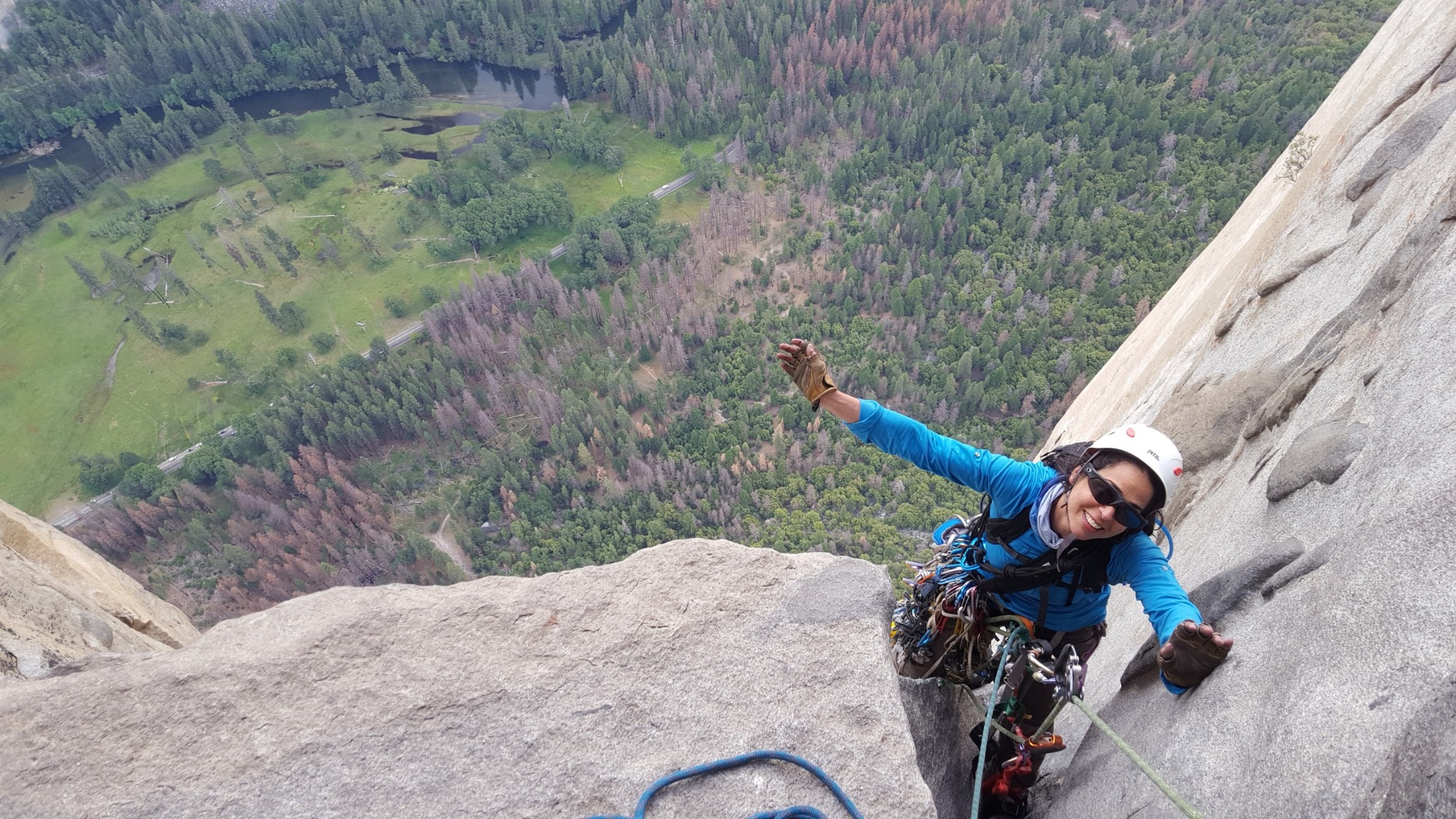
In June 2017 Trina arrived in Yosemite once again, this time to climb The Nose on El Capitan, one of the most iconic and famous climbs in the world. Dedicating the climb to the Crohn’s & Colitis Foundation, she raised an incredible $36,435 which went to research to find a cure for the disease. The day prior to starting her climb, Alex Honnold stunned the world by free-soloing Freerider, a 5.13 climb. He does the climb without a rope in 3h56m. Trina plans to take 5 days...
The Route...
Trina and her climbing guide Mark Grundon.
Day 1 Camp at Sickle Ledge
Meeting one of Yosemite’s legends Hans florine at Sickle Ledge as he sped by. Hans has held the speed record for climbing the Nose
Lower out to move laterally between two flake systems, just before Stovelegs Crack. Photo: Tom Evans
Portaledge camp at Dolt Tower
Camp IV Thursday June 8 Trip Update: Trina sent some video from Camp IV where she is spending the night. (see on map on the second picture). This is a little more than half way but the second half is more vertical and more technical causing slower progress. 40% change of rain tomorrow morning, so they may have to wait that out, but they are prepared for it. The next major feature is "The Great Roof" which is like it's name says, a huge roof that they need to climb out and around. Trina says it looks pretty intimidating from where she is now below it. If all goes well she should summit on Saturday and do the 6 hour hike down on Sunday.
“The Great Roof” is a major feature on the climb which is exactly what it’s name says.
The route goes under and around to the right. It looks very intimidating from far, and even more so up close.
Day 4 of the climb
Day 5: Big Air on the final pitch. It was not an easy ending. The last pitch was the most technical and challenging of the entire climb. It was severely overhanging leaving the climber fully exposed and dangling on the end of the rope, very aware of how high 2900ft actually is.
Touching El Cap's one tree at the summit is the traditional end to the climb.
© 2024 Trina Seligman. All Rights Reserved.